
South African Learners Earn Five International Honours At IMO 2026
South Africa has won one silver medal, one bronze medal and three Honourable Mentions at the 67th International Mathematical Olympiad (IMO), held in Shanghai, China, from 10–20 July 2026. The 2026 IMO brought together 666 contestants from 117 countries.
How the IMO works
Although learners represent their countries, the IMO is an individual competition. Each country may send up to six contestants. Over two consecutive days, each contestant has four and a half hours to solve three problems per day. Contestants must build clear mathematical arguments and proofs without books, calculators, computers or communication devices. The questions test insight, logic, creativity and persistence rather than routine classroom methods.
South Africa’s 2026 IMO team
|
Learner |
Grade |
School |
Province |
2026 IMO result |
|
Eli Williams |
12 |
Westerford High School |
Western Cape |
Silver medal |
|
Pocoyo Pun |
11 |
Elkanah House |
Western Cape |
Bronze medal |
|
Vincent Wang |
12 |
Deutsche Internationale Schule Pretoria |
Gauteng |
Honourable Mention |
|
Noah Greenblatt |
12 |
King David High School |
Gauteng |
Honourable Mention |
|
Xiaoyuan Li |
11 |
St John’s College |
Gauteng |
Honourable Mention |
|
Noah Rassou |
12 |
South African College High School |
Western Cape |
Participant |
Team Leader: Ms Kerry Porrill, Stellenbosch University
Deputy Team Leader: Ms Yian Xu, Massachusetts Institute of Technology
Why an Honourable Mention matters
An Honourable Mention is a significant international achievement. Under the IMO regulations, a contestant who does not receive a gold, silver or bronze medal earns an Honourable Mention only if they score the full points on at least one problem.
In practical terms, the learner must produce a complete and correct solution to at least one of the six problems set for the strongest young mathematicians in the world. It is therefore far more than a certificate of participation; it is proof that the contestant solved an IMO problem at the highest scoring level.
A journey built over many years
A place in the South African team is not decided by one strong performance. For many learners, the journey begins in the Foundation Phase through the International Kangaroo Mathematics Competition for Grades 1 to 3. Learners can then strengthen their problem-solving skills through the South African Mathematics Challenge (SAMC) for Grades 4 to 7 and the South African Mathematics Olympiad (SAMO) for Grades 8 to 12.
Strong performance in SAMO opens the door to the SA Mathematics Olympiad Training Programme. Through regular training, demanding assignments and intensive camps, learners develop from promising problem-solvers into candidates who may be considered for the national team. The process can span most of a learner’s school career, and selection remains highly competitive until the final team is chosen.
South Africa’s history at the IMO
South Africa first participated in the IMO in 1992 and has taken part every year since. The 2026 competition marks the country’s 35th consecutive appearance.
Including the 2026 results, South African contestants have earned one gold medal, 13 silver medals, 60 bronze medals and 82 Honourable Mentions. This brings the country’s cumulative record to 74 medals and 82 Honourable Mentions—156 international recognitions in total.
“A silver medal, a bronze medal and three Honourable Mentions are not results achieved in a few weeks,” says Prof Seithuti Moshokoa, Executive Director of the South African Mathematics Foundation. “They are the outcome of years of curiosity, disciplined practice and support from families, teachers and coaches. Every member of this team has earned the right to stand among the world’s strongest young problem-solvers. We congratulate them for representing South Africa with courage and distinction, and we hope their journey shows younger learners that mathematical excellence can be built step by step.”
2026 country rankings
The People’s Republic of China placed first, followed by the United States of America and Russia. South Africa ranked 57th and shared the position with Argentina, New Zealand and Ireland.
|
Rank |
Country |
Note |
|
1 |
People’s Republic of China |
Top-ranked team |
|
2 |
United States of America |
Second |
|
3 |
Russia |
Third |
|
57 |
South Africa |
Tied with Argentina, New Zealand and Ireland |
Top three individual contestants
Three contestants from the People’s Republic of China shared first place among the 666 participants.
|
Rank |
Contestant |
Country / region |
|
Joint 1st |
Leyan Deng |
People’s Republic of China |
|
Joint 1st |
Che Liu |
People’s Republic of China |
|
Joint 1st |
Bolun Zhang |
People’s Republic of China |
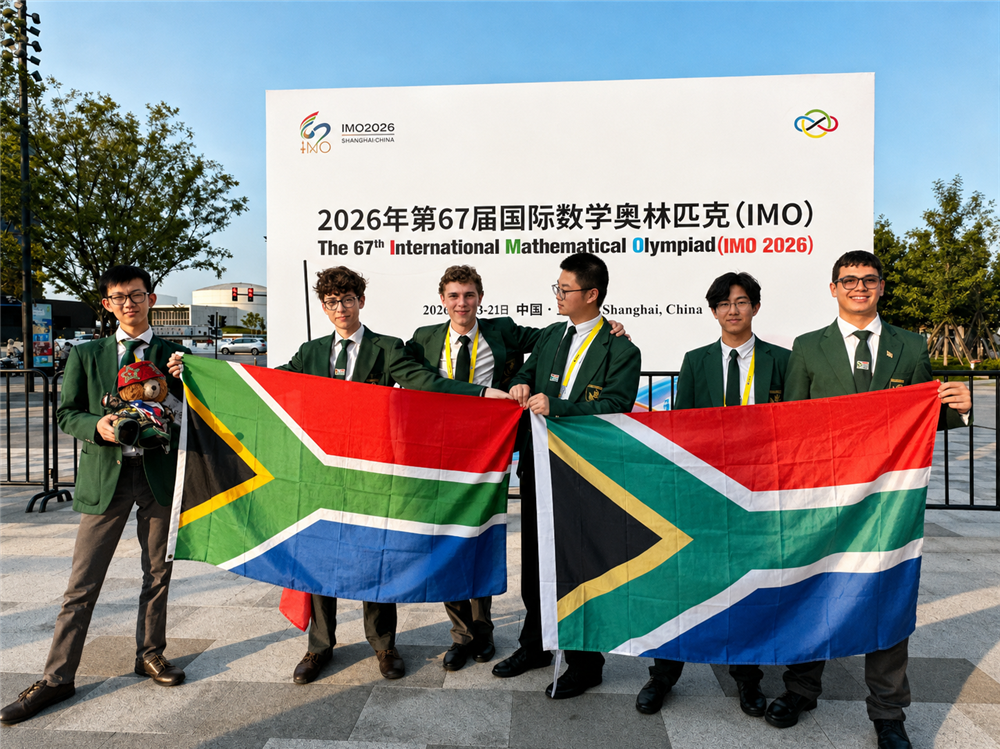
From left to right: Pocoyo Pun, Eli Williams, Noah Greenblatt, Xiaoyuan Li, Vincent Wang, Noah Rassou